Fabric weight is the specification most buyers skip when ordering custom flannel, and it is the one they notice every time the shirt goes on. Weight decides whether a flannel reads as a breathable overshirt or a structured shacket, how a print or stitch sits on the brushed surface, and how much the garment shrinks after its first wash. Nailing it down at the order stage costs nothing. Getting it wrong means a run of shirts that feel thin, pill within a season, or no longer match the size chart you approved.
How flannel weight is actually measured
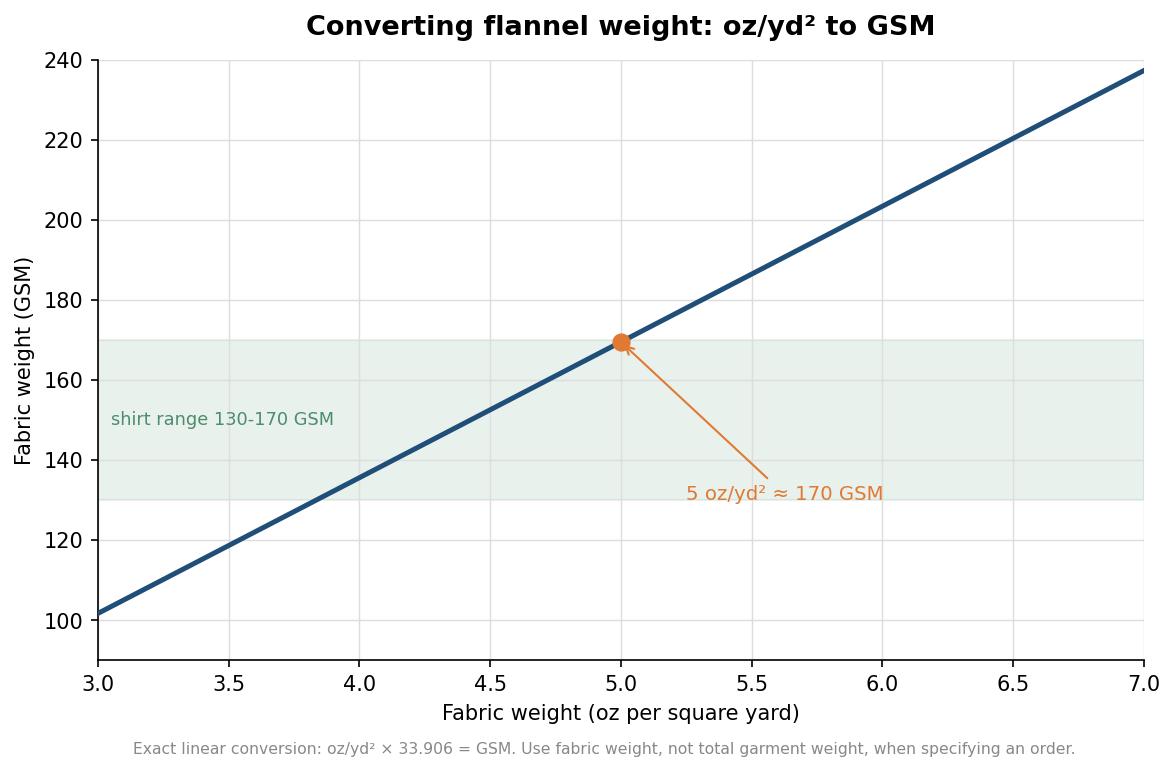
Flannel weight is quoted two different ways, and confusing them is where orders go sideways. The number that matters for fabric is weight per unit area, given either in grams per square meter (GSM) or ounces per square yard (oz/yd²). The two convert directly: multiply oz/yd² by 33.906 to get GSM, so a common 5 oz/yd² flannel works out to roughly 170 GSM. Shirt-weight flannel generally sits between about 130 and 170 GSM, or 3.8 to 5.0 oz/yd².
The second figure you will see, usually in retail marketing, is total garment weight — a brand calling a shirt “over 15 ounces,” for instance. That number describes the finished garment, buttons and all, and it is not comparable to fabric GSM. It is useful shorthand for “this feels substantial,” but it is the wrong figure to spec an order against. When you brief a decorator or manufacturer, always give GSM or oz/yd².
The three weight classes and what each is for
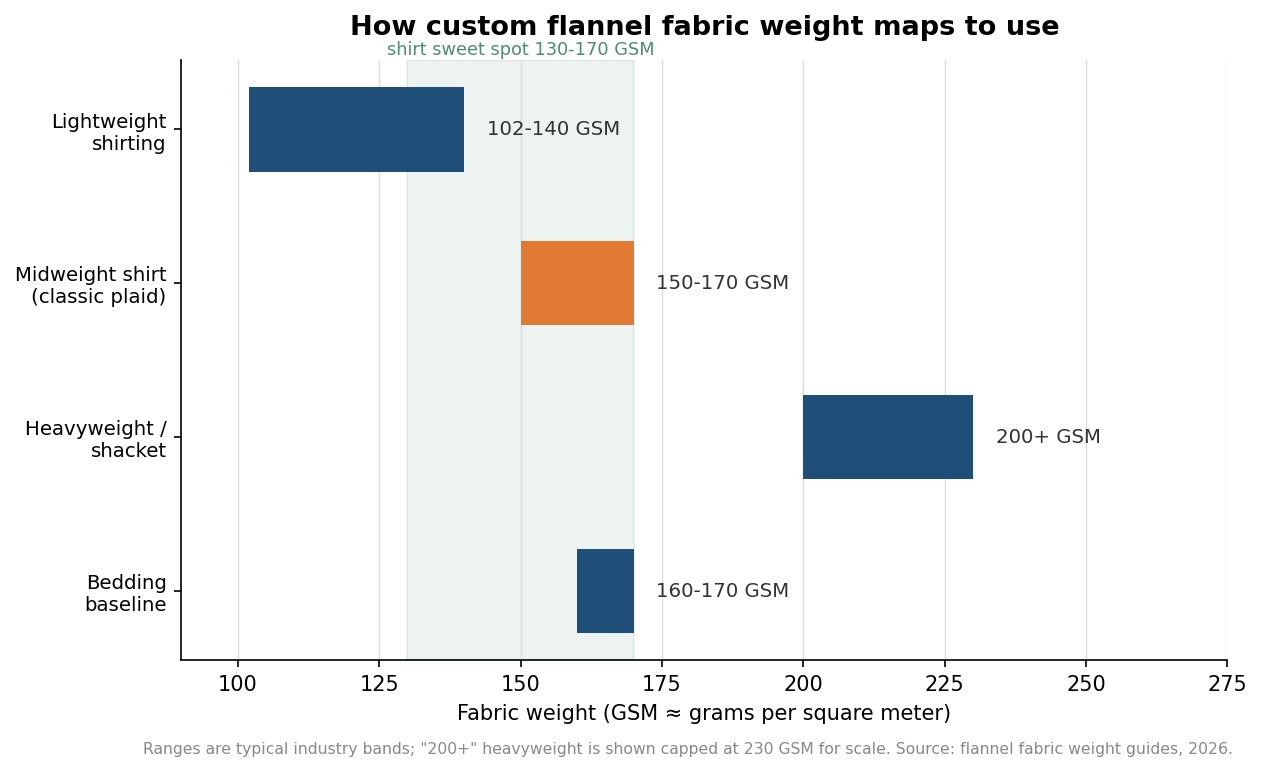
Lightweight flannel runs about 102 to 140 GSM (3.0 to 4.1 oz/yd²). It drapes softly and breathes, which suits warm-weather shirting, women’s blouses, and promotional shirts meant to be worn indoors or layered lightly. Midweight, roughly 150 to 170 GSM (4.4 to 5.0 oz/yd²), is the classic plaid shirt most people picture: warm enough for fall, structured enough to hold a logo cleanly, light enough to wear all day. Heavyweight starts around 200 GSM (5.9 oz/yd² and up) and crosses into shacket and light-outerwear territory. For most custom flannel programs, the 130 to 170 GSM band is the safe target; go lighter for events and giveaways, heavier only when the shirt is meant to function as a jacket. Keep in mind that mills quote a nominal weight with a tolerance of a few percent, so a fabric sold as 160 GSM may test slightly above or below that figure; if the spec is tight, ask what tolerance the mill works to.
Heavier is not automatically warmer
It is tempting to read GSM as a warmth score, but that is not how flannel works. Warmth comes largely from the brushed nap that traps air against the body, and brushing quality varies independently of weight. A well-executed double-brushed 160 GSM flannel can feel warmer than a flat, single-brushed 180 GSM one, because the raised fibers do more of the insulating work. This is why premium makers emphasize double brushing, which raises surface fibers on both faces of the cloth. The tradeoff to watch is pilling: heavier flannels often rely on softer, lower-twist yarns, and those tend to pill more readily than a tightly spun midweight. If longevity across many washes matters more than maximum plushness, a well-made midweight is frequently the smarter buy.
How weight changes the rest of your order
Decoration behaves differently on different weights. Embroidery sits well on midweight and heavier napped fabric, where the base cloth supports a dense stitch — a reason it is the go-to for left-chest logos and names. Screen printing is strongest for bold, solid areas of color, but fine detail can sink into a raised nap, so on heavily brushed fabric many shops steer detailed or photographic art toward direct-to-film (DTF) instead. Minimums track the method: screen printing often begins around a six-piece minimum, while DTF is frequently offered with no minimum, and add-ons such as individual names run in the range of a few dollars per name. Treat those figures as indicative and confirm them with your supplier, since they vary by shop and blank.
Shrinkage quietly moves your size chart. Brushed cotton flannel typically carries a 5 to 6 percent shrinkage allowance, while Sanforized fabric can hold under 3 percent. On a shirt sized for a 42 to 45 inch chest at Large, an unmanaged 5 to 6 percent can pull the garment down close to the next size after washing. Before you approve a size chart, ask two questions: is the fabric Sanforized, and are the measurements pre-wash or post-wash. Getting those answers in writing prevents the most common post-delivery complaint, which is that the shirts “came up small.”
Weight also nudges lead time. Decorating stock flannel blanks is fast — turnarounds around six business days are common for straightforward jobs — while cut-and-sew from a chosen fabric weight takes considerably longer and should be planned weeks out. If you have a hard in-hand date, lock the weight and blank early rather than late.
How to specify it cleanly
When you place the order, hand your supplier five things: the fabric weight in GSM or oz/yd², the composition (100 percent cotton versus a cotton-poly blend), the brushing (single or double), whether the fabric is Sanforized, and the decoration method matched to that weight. Those five lines turn “a nice flannel” into a spec a factory can actually hit, and they are the difference between a sample you love and a bulk run that matches it. It also helps to order and keep a sealed reference sample of the approved fabric, so any disagreement over a production run can be settled against a physical standard rather than someone’s memory of how the sample felt.
Win Free Stuff
Enter below for a chance to win plus receive 10% off your first order.
🎉 You are in!
Check your email for your 10% off code. Good luck!