Two custom flannels can share the same plaid, the same weight, and the same price and still behave completely differently in the wash, on the body, and after a season of wear. The reason is fiber content. Whether a shirt is spun from 100 percent cotton or a cotton-polyester blend decides how soft it feels, how much it shrinks, how long it holds its shape, and how a printed logo ages on it. Fiber content is a separate specification from fabric weight, and on a bulk order it is worth deciding on purpose rather than accepting whatever the blank happens to be.
What 100 percent cotton gives you, and what it costs
Cotton is the comfort benchmark. Brushed cotton flannel has the softest hand, breathes the best, and absorbs moisture instead of trapping it against the skin, which is why it reads as the warmest and most natural against the body. For a retail-quality piece, a gift, or anything people will choose to wear off the clock, pure cotton is usually what they mean when they picture a good flannel.
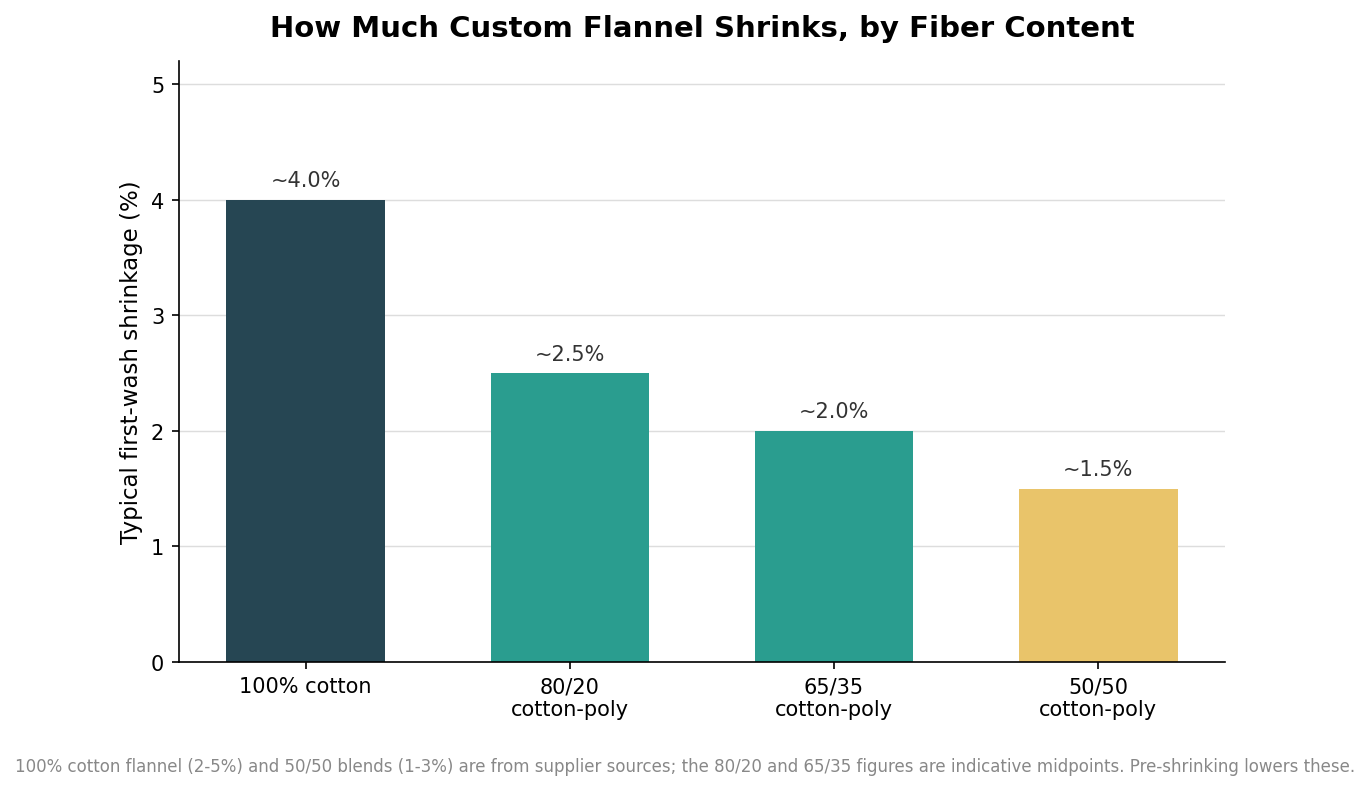
The trade-offs are dimensional. Cotton shrinks: a 100 percent cotton flannel typically loses about 2 to 5 percent after its first hot wash, often in the 3 to 5 percent range, and cheaper goods can pull in as much as 10 percent, which works out to roughly one to two inches per yard of fabric. It also wrinkles more, loses its shape faster over months of wear, and takes longer to dry. Most of the shrink can be removed at the mill through pre-shrinking, or sanforizing, but even pre-shrunk cotton will move a little under very hot water or a high dryer setting.
What a polyester blend changes
Adding polyester trades a little of that soft, airy hand for stability and toughness. A 50/50 or 65/35 cotton-poly flannel shrinks far less, on the order of 1 to 3 percent for a 50/50, keeps its shape, resists wrinkles, dries faster, and generally costs less to produce. Blends also tend to hold printed color longer, so graphics stay vibrant through more wash cycles. The cost is comfort: a blend is still breathable thanks to the cotton in it, but it is not quite as soft or as airy as pure cotton, and some wearers notice. There is a decoration angle too: embroidery sits well on either fabric, while the polyester in a blend helps a screen print hold its color through repeated washing, and a soft, high-cotton flannel is the more forgiving surface for a large, detailed print.
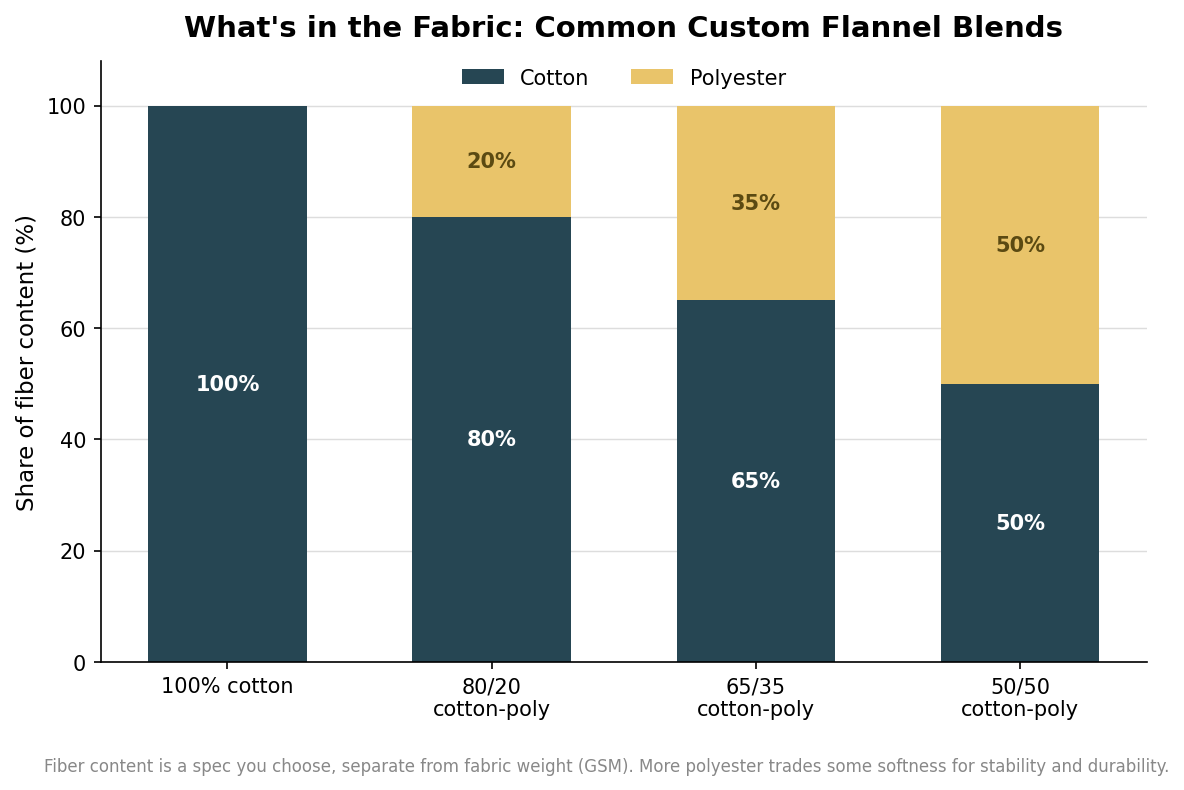
Blends are not a single thing. An 80/20 leans cotton and feels close to pure cotton while gaining some stability; a 65/35 sits in the practical middle; a 50/50 maximizes durability, shape retention, and shrink resistance at the largest cost to softness. The more polyester in the mix, the more the shirt behaves like a workwear or uniform piece and the less it behaves like a soft weekend flannel.
Shrinkage is the spec that bites team orders
Shrinkage matters most when you are ordering a run of sized garments for a group, because a shirt that fits in the box can fit differently after the first home wash. If everyone launders on hot and tumble dries, a 100 percent cotton order can drift a full size for some wearers, while a blend holds much closer to its labeled measurements. The two ways to protect a sized order are to specify pre-shrunk cotton, or to choose a blend, and then to give recipients simple care guidance.
Care instructions do real work here. Washing in cold or lukewarm water on a gentle cycle, drying on low heat or air drying, and pulling shirts out while still slightly damp keeps both cotton and blends near their intended size. It is worth printing that guidance on a hang tag or an insert for a customer-facing order, since the fabric you chose only performs as intended if it is laundered the way it was designed for.
Matching the fabric to the job
The choice gets easier once you tie it to how the shirt will be used. For retail merch, premium gifts, and hospitality or lifestyle brands where the flannel is part of the appeal, lean toward 100 percent cotton, ideally pre-shrunk, and accept a little more care and wrinkling in exchange for the best hand. For uniforms, field crews, event staff, and any setting where shirts are washed hard and often and need to look consistent across a whole team, a 65/35 or 50/50 blend earns its keep through shape retention, shrink resistance, and longer-lasting decoration. An 80/20 is a sensible hedge when you want most of cotton’s feel with a measure of insurance against shrinkage.
Decide fiber and weight together
Fiber content and fabric weight are two separate dials, and the best orders set them deliberately as a pair. A heavier brushed cotton makes a plush, cool-weather shirt but leans into cotton’s shrink and wrinkle tendencies; a mid-weight blend makes a durable, low-maintenance shirt that holds up to constant laundering. Decide first what the shirt has to survive and how soft it has to feel, choose the fiber content to match, then pick a weight in that fabric, and confirm both on the spec sheet before the order runs. Getting fiber content right up front is what keeps a flannel order from feeling like the wrong shirt once it has been through a few washes.