When a business orders custom flannel, most of the decisions that determine whether people actually wear the shirt are made before a single stitch of embroidery goes down. The blank you choose sets the weight, the fit, the fiber blend, the size range, and how cleanly a logo will sit on the chest. The decorated-apparel industry keeps coming back to a short list of flannel blanks, and they are not interchangeable. This is a side-by-side look at three of the most commonly ordered models, what the spec sheets actually say, and how those differences play out once the shirt is on a body.
The three that show up on almost every quote
If you gather quotes for branded flannel, you will keep seeing the same names. The Port Authority W668 is the lightweight, retail-styled option: a 60/40 cotton-poly plaid listed at roughly 4.4 ounces per square yard, lightly brushed, with a bias-cut back yoke, double chest pockets with flaps, and a size range that runs XS through 4XL. The Burnside 8219 is the heavier, more rugged snap-front shirt, an 80/20 cotton-poly build listed around 5.4 ounces with two chest pockets, roll-up sleeves, and adjustable cuffs. The Independent Trading EXP50F sits at the top of this group for substance, a 60/40 blend listed at 200 gsm, which works out to about 5.9 ounces per square yard, cut as a unisex shirt-jacket with double flap pockets, roll-up sleeve vents, and a tear-away neck label, in XS through 3XL.
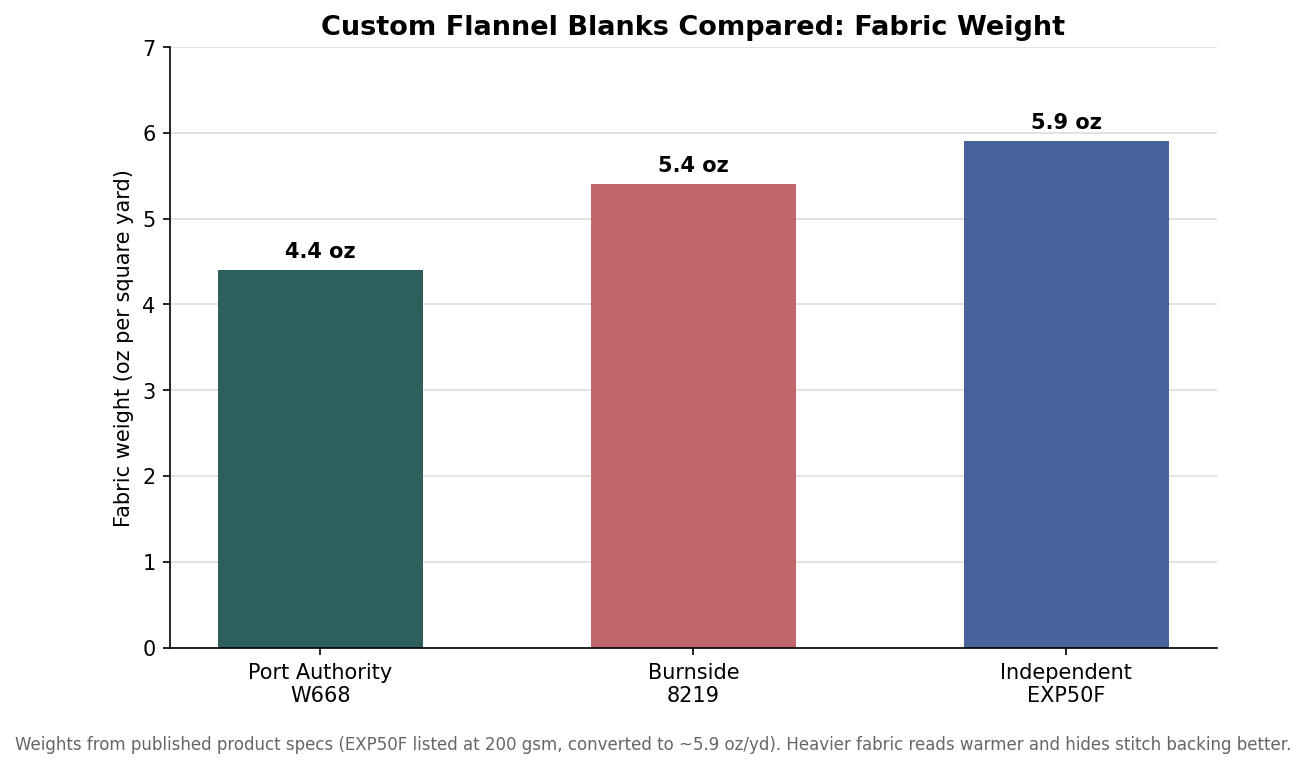
That weight spread from about 4.4 to 5.9 ounces looks small on paper but is very noticeable in hand. The W668 wears like a shirt you would layer under a jacket; the EXP50F wears like the jacket. If your team will live in these shirts through a cold season, or if you want the garment to read as a premium giveaway, the heavier fabric justifies its higher blank cost. If the flannel is a warm-weather brand piece or a uniform layer worn indoors, the lighter W668 is more comfortable and usually less expensive per unit.
Fiber blend changes care as much as feel
The cotton-to-polyester ratio is the spec buyers overlook most, and it drives two things that matter after the sale: how the shirt feels and how it survives laundering. The Burnside 8219 leans hardest into cotton at 80/20, which gives it the softest, most natural hand and the richest color in a yarn-dyed plaid, at the cost of more shrinkage and wrinkling over time. The W668 and EXP50F both sit at 60/40, trading a little softness for meaningfully better shrink resistance and easier care, which is exactly what you want when a shirt is worn hard and washed often by staff who will not baby it.
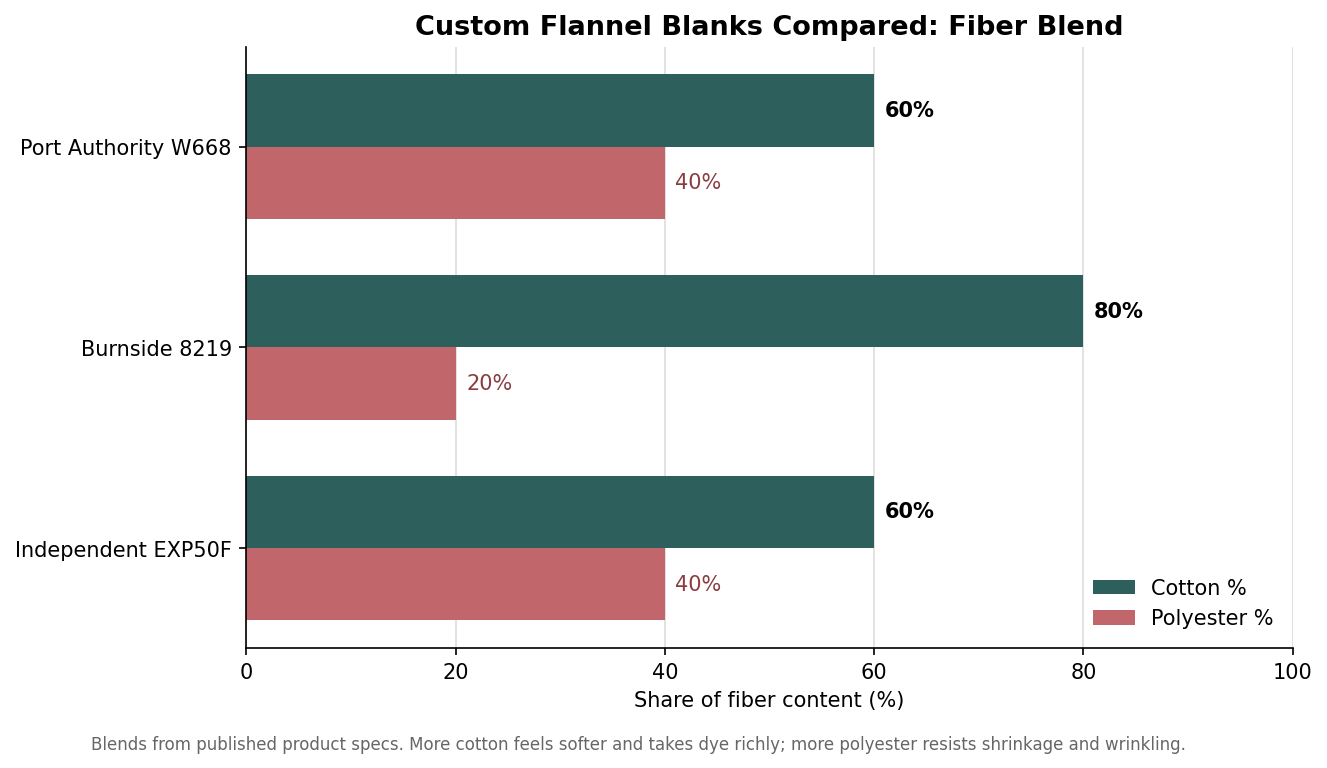
There is a decoration angle here too. Higher cotton content takes dye deeply and gives embroidery a plush, slightly recessed look as the stitches settle into a brushed surface. A higher-polyester blend holds its shape better under a hoop and is less prone to the puckering that can show up when dense stitching pulls on an all-cotton weave. Neither is wrong; it is a question of whether you are optimizing for the softest hand or the crispest, most stable logo.
Fit, size range, and who actually gets a shirt that fits
Size range is a practical constraint that quietly decides how inclusive your order can be. The W668’s XS-through-4XL run is the broadest of the three and the safest choice for a mixed team where you cannot predict who needs what. The EXP50F tops out at 3XL and is cut unisex, which simplifies ordering but fits differently on different body types, so it is worth ordering a couple of sizes as samples before committing a whole staff. Burnside publishes its 8219 in a modern fit that runs closer to the body than a traditional boxy flannel, which flatters some wearers and frustrates others; if in doubt, size up.
Where a garment offers a distinct women’s or ladies’ counterpart, ordering it rather than handing everyone the same unisex cut is usually the difference between a shirt that gets worn and one that lives in a drawer. The point of branded flannel is that people choose to put it on, and fit is the biggest lever on that.
Matching the blank to the job
Reduced to a decision, the pattern is straightforward. Choose the lighter W668 when you want a broad size range, a lower per-unit cost, and a retail look for a warm climate or an indoor uniform. Choose the Burnside 8219 when you want the softest, most authentic cotton hand and the character of a snap-front work shirt, and you can accept a little more shrinkage in exchange. Choose the Independent EXP50F when you want the most substantial, jacket-like piece that will read as a premium item and hold up as outerwear.
Two things to confirm before you sign off, regardless of model. First, order blank samples in the exact colors and a couple of sizes so you can feel the weight and check the fit rather than trusting a spec sheet alone; the numbers here are drawn from published product specifications and are a starting point, not a substitute for handling the garment. Second, pin down the decoration method and placement early, because an 80/20 brushed cotton and a 60/40 blend do not behave identically under a needle, and a quick stitch-out on the actual fabric will tell you more than any comparison chart. Get the blank right and the branding is the easy part.
Win Free Stuff
Enter below for a chance to win plus receive 10% off your first order.
🎉 You are in!
Check your email for your 10% off code. Good luck!