A custom flannel order looks its best the afternoon it arrives: crisp plaid, clean stitching, everyone reaching for their size. The real test comes twenty washes later, when the shirts have either held their shape or turned into a drawer of tight, pilled, faded seconds. The difference is rarely luck. It is decided at the order stage, in the fabric you specify and the decoration method you approve, long before anyone runs a load of laundry.
This guide walks through the choices that determine whether a run of custom flannel still fits and still carries a clean logo a year from now. None of it is exotic. It is mostly about knowing which questions to ask a supplier before you sign off on a sample.
How much cotton flannel actually shrinks
Untreated 100% cotton flannel is the biggest variable. A single hot wash and hot dry commonly pulls it in by 3 to 5 percent, and on cheaper, loosely woven goods people report up to around 10 percent. Five percent does not sound dramatic until you translate it: on a shirt with a 31-inch body length, that is roughly an inch and a half, enough to move a wearer from a comfortable fit to a shirt that rides up. Most of that movement happens in the first one or two washes; after that, additional shrinkage is usually minor, on the order of 1 to 2 percent.
Pre-shrunk and sanforized cotton behave far better. These fabrics are compacted at the mill so most of the shrink is taken out before the garment is cut. They can still tighten slightly under very hot water or a high dryer setting, but they hold their measurements much more predictably, which matters enormously when you are ordering a size run for a team and cannot afford surprises. Blends shift the math again: a 50/50 cotton-polyester flannel typically moves only about 1 to 3 percent on the first wash, and fabrics with a high polyester content can be close to dimensionally stable.
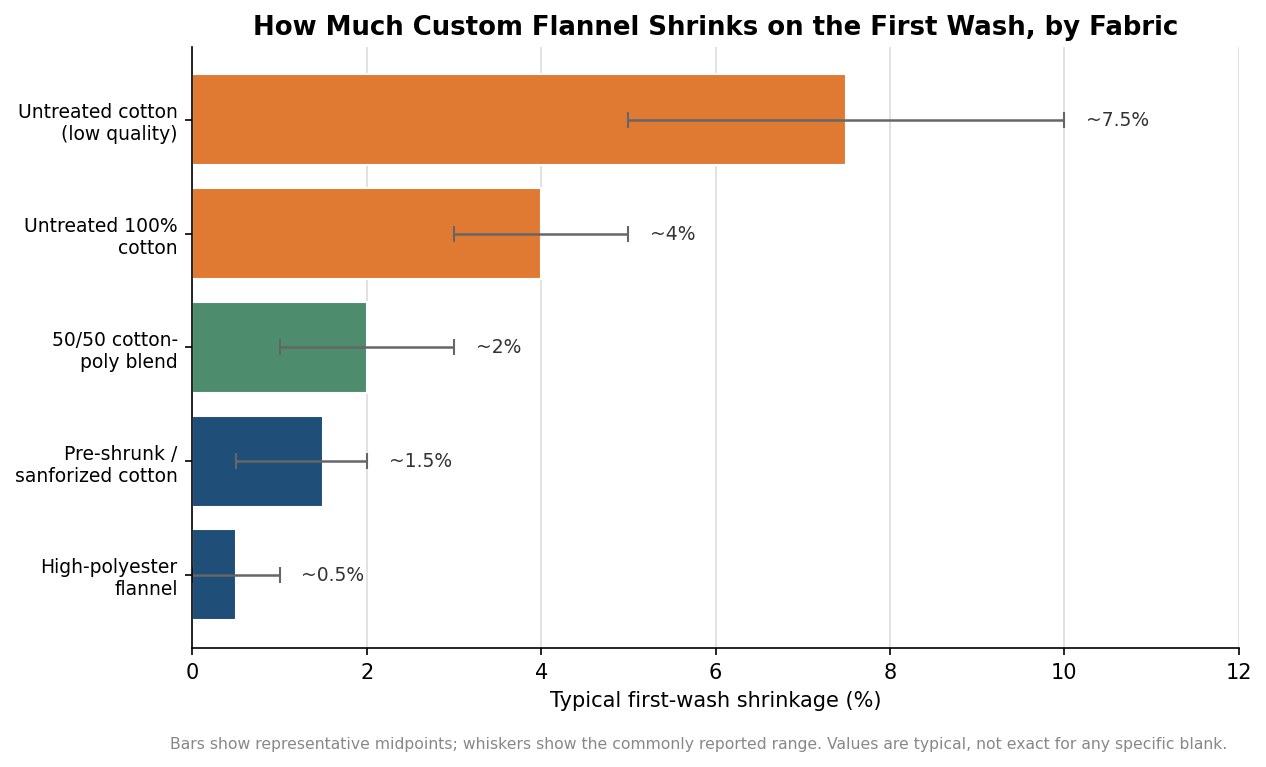
The practical takeaway for an order is to treat the fabric spec as a shrinkage decision, not just a hand-feel decision. If you want the pure-cotton look and feel, ask specifically whether the blank is pre-shrunk or sanforized rather than assuming it is. If dimensional stability across many washes is the priority, a cotton-rich blend gives up a little softness in exchange for holding its size.
Build a size margin into the order
Even with good fabric, the safe move on a team order is to plan for a small amount of shrinkage rather than hope for none. Because cotton flannel tightens most in the body length and sleeves, ordering pure-cotton pieces one increment of length up, or choosing a cut with a slightly longer tail, absorbs the first-wash pull without leaving anyone in a crop. The cheapest insurance of all is a wash test: buy or request one sample per fabric before committing, launder it the way your wearers actually will, and measure it before and after. A supplier who is confident in a blank will not object to this, and the half-hour it takes can save an entire reorder.
Weight, nap, and the pilling trade-off
Flannel weight is measured in grams per square meter, and shirt fabric spans a wide band. Lightweight flannels run roughly 120 to 140 GSM (about 3.5 to 4.1 ounces per square yard) and suit warmer seasons and drapier cuts. The classic mid-weight shirt sits around 150 to 170 GSM (roughly 4.4 to 5 ounces), which is where most standard custom flannels land. Heavyweight goods of 200 GSM and up move into shirt-jacket, or “shacket,” territory, warm enough to work as a light outer layer. A useful reference point is that 5 ounces per square yard is about 170 GSM.
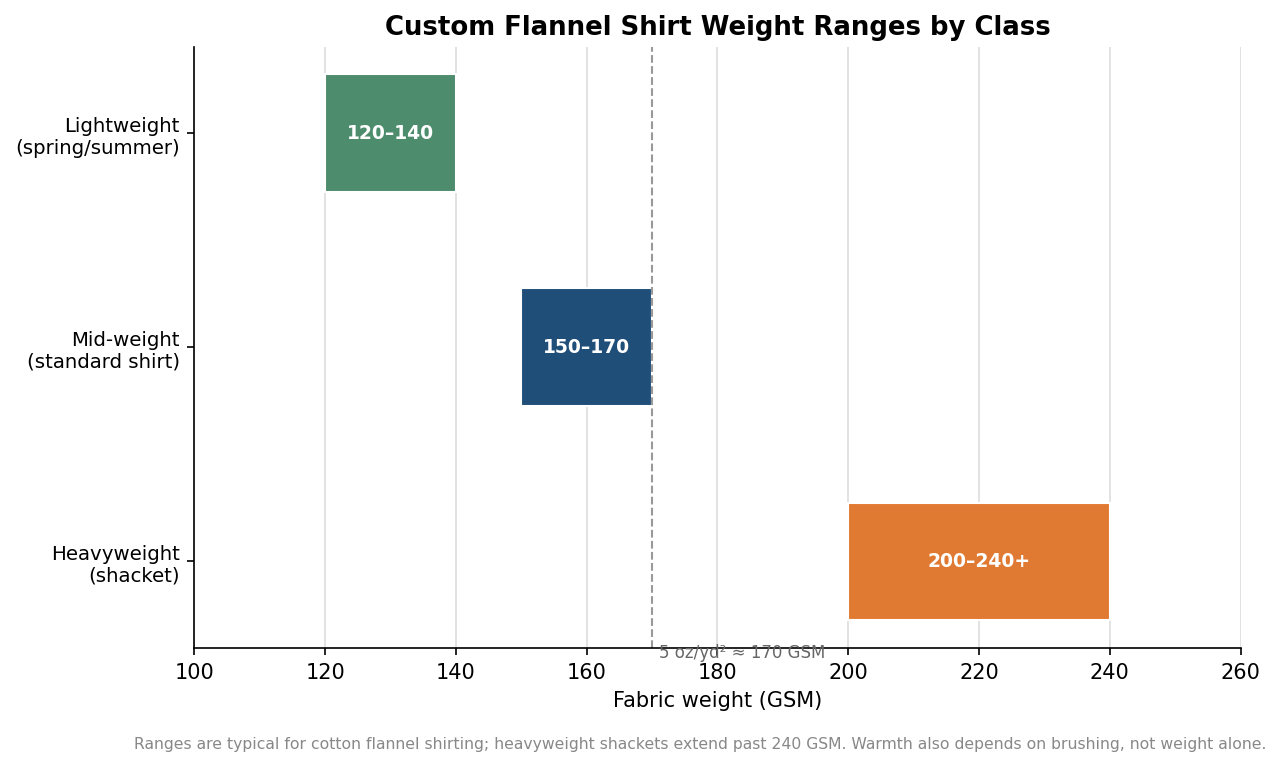
Heavier does not automatically mean tougher. Counterintuitively, denser flannels often pill more, because the plush hand usually comes from softer, lower-twist yarns that shed fibers more readily under friction at the cuffs and where a bag strap rubs. Warmth is not purely a weight story either: it comes largely from the brushed nap that traps air, so a well-brushed 160 GSM fabric can feel warmer than a flatter 180 GSM one. When you are choosing a blank, ask about the brushing and the yarn as well as the raw weight, because those are what you actually feel and what pills first.
Decoration that survives the nap
Flannel is a napped, textured surface, which changes how decoration wears. Embroidery is generally the most durable choice on flannel because the stitches sit in the fabric rather than on top of it, so they shrug off repeated laundering. It reads best as a left-chest logo or a small sleeve mark, and it wants a stable backing so the design does not distort as the soft fabric moves. Screen printing and direct-to-garment printing can look sharp on day one, but ink laid over a raised nap has a harder life, and prints can crack or fade faster on flannel than on a smooth tee, especially across a plaid where the surface is uneven. If you do print, keep the design where the fabric is flattest and discuss a base layer that helps ink sit above the nap.
Placement is part of durability too. A logo over a chest pocket seam or across a button placket sits on moving, uneven ground and shows wear sooner, so keeping decoration on flat, stable panels pays off over the life of the shirt.
The care instructions worth printing on the tag
Once you have specified well, most of the remaining risk is in how the garments are washed, and that is worth communicating to whoever wears them. Cold or lukewarm water and a low or air dry prevent the great majority of avoidable shrinkage, because heat is what swells and sets the fibers. Removing shirts from the dryer while still slightly damp and letting them finish on a hanger protects both the fit and any print. A gentle detergent with no bleach and no fabric softener keeps colors and the brushed surface intact; softener in particular coats the nap and can accelerate pilling. For embroidered pieces, turning them inside out reduces abrasion on the stitching. None of this is demanding, but a run of flannel that is washed cold and dried low will outlast an identical run washed hot every time.
Specify the fabric with shrinkage in mind, leave yourself a little size margin, match the decoration to the surface, and hand wearers a simple care routine. Do those four things and a custom flannel order stays a uniform people are glad to wear rather than a reorder you did not budget for.