Category: Uncategorized

  • Will Your Custom Flannel Survive the Wash? Specifying for Shrinkage and Durability

    Will Your Custom Flannel Survive the Wash? Specifying for Shrinkage and Durability

    Call or Text us: (929) 605-4397

    Will Your Custom Flannel Survive the Wash? Specifying for Shrinkage and Durability

    A custom flannel order looks its best the afternoon it arrives: crisp plaid, clean stitching, everyone reaching for their size. The real test comes twenty washes later, when the shirts have either held their shape or turned into a drawer of tight, pilled, faded seconds. The difference is rarely luck. It is decided at the order stage, in the fabric you specify and the decoration method you approve, long before anyone runs a load of laundry.

    Choosing between two ways to add warmth? See our heavyweight vs. sherpa-lined flannel shirts comparison.

    This guide walks through the choices that determine whether a run of custom flannel still fits and still carries a clean logo a year from now. None of it is exotic. It is mostly about knowing which questions to ask a supplier before you sign off on a sample.

    How much cotton flannel actually shrinks

    Untreated 100% cotton flannel is the biggest variable. A single hot wash and hot dry commonly pulls it in by 3 to 5 percent, and on cheaper, loosely woven goods people report up to around 10 percent. Five percent does not sound dramatic until you translate it: on a shirt with a 31-inch body length, that is roughly an inch and a half, enough to move a wearer from a comfortable fit to a shirt that rides up. Most of that movement happens in the first one or two washes; after that, additional shrinkage is usually minor, on the order of 1 to 2 percent.

    Pre-shrunk and sanforized cotton behave far better. These fabrics are compacted at the mill so most of the shrink is taken out before the garment is cut. They can still tighten slightly under very hot water or a high dryer setting, but they hold their measurements much more predictably, which matters enormously when you are ordering a size run for a team and cannot afford surprises. Blends shift the math again: a 50/50 cotton-polyester flannel typically moves only about 1 to 3 percent on the first wash, and fabrics with a high polyester content can be close to dimensionally stable.
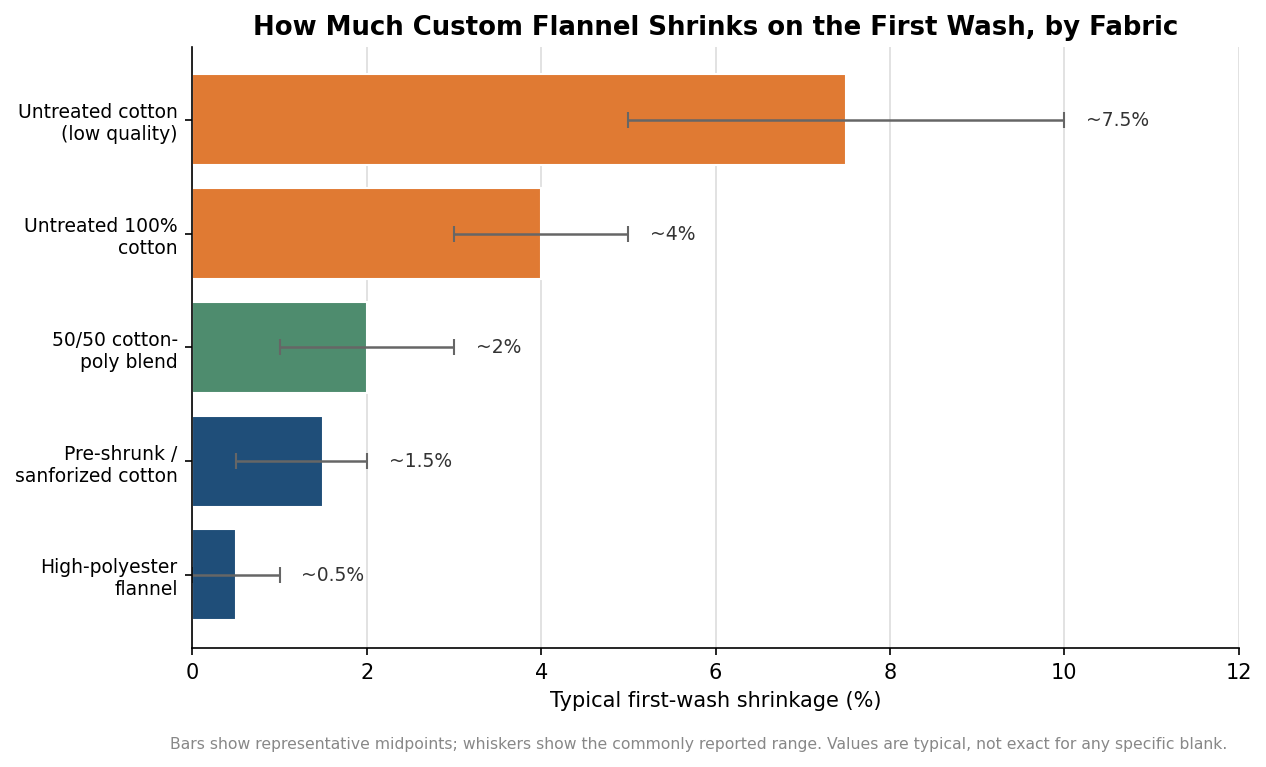
    Horizontal bar chart of typical first-wash shrinkage for untreated cotton, blends, and pre-shrunk flannel
    Untreated cotton flannel shrinks most on the first wash; pre-shrunk and blended fabrics stay far more stable.

    The practical takeaway for an order is to treat the fabric spec as a shrinkage decision, not just a hand-feel decision. If you want the pure-cotton look and feel, ask specifically whether the blank is pre-shrunk or sanforized rather than assuming it is. If dimensional stability across many washes is the priority, a cotton-rich blend gives up a little softness in exchange for holding its size.

    Build a size margin into the order

    Even with good fabric, the safe move on a team order is to plan for a small amount of shrinkage rather than hope for none. Because cotton flannel tightens most in the body length and sleeves, ordering pure-cotton pieces one increment of length up, or choosing a cut with a slightly longer tail, absorbs the first-wash pull without leaving anyone in a crop. The cheapest insurance of all is a wash test: buy or request one sample per fabric before committing, launder it the way your wearers actually will, and measure it before and after. A supplier who is confident in a blank will not object to this, and the half-hour it takes can save an entire reorder.

    Weight, nap, and the pilling trade-off

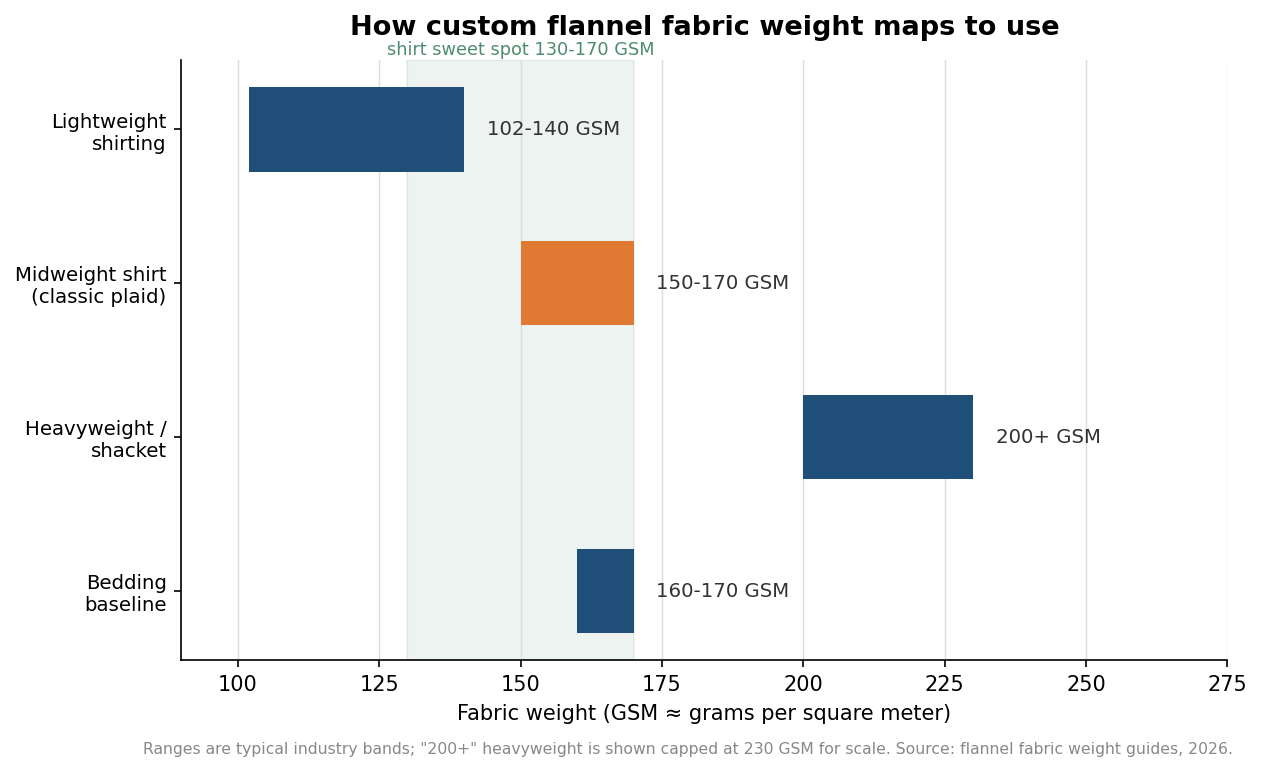
    Flannel weight is measured in grams per square meter, and shirt fabric spans a wide band. Lightweight flannels run roughly 120 to 140 GSM (about 3.5 to 4.1 ounces per square yard) and suit warmer seasons and drapier cuts. The classic mid-weight shirt sits around 150 to 170 GSM (roughly 4.4 to 5 ounces), which is where most standard custom flannels land. Heavyweight goods of 200 GSM and up move into shirt-jacket, or “shacket,” territory, warm enough to work as a light outer layer. A useful reference point is that 5 ounces per square yard is about 170 GSM.
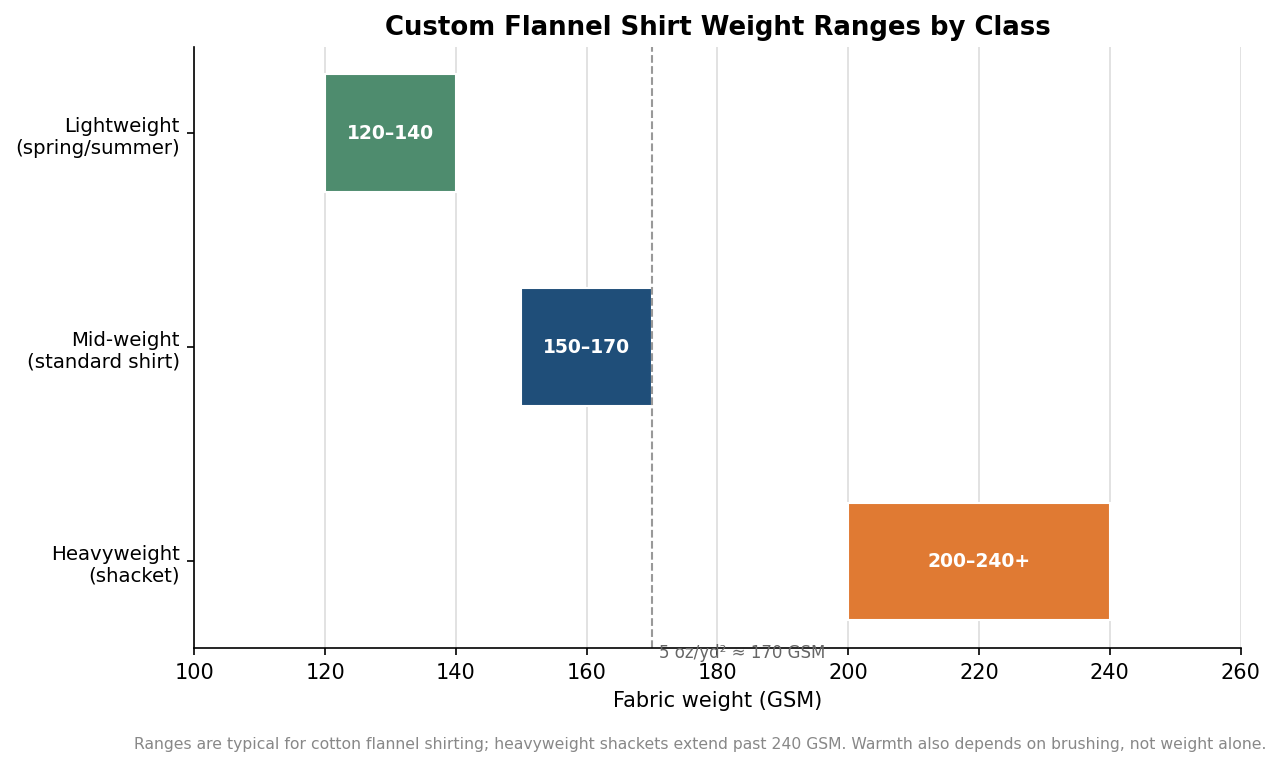
    Horizontal range bars showing GSM weight ranges for lightweight, mid-weight, and heavyweight flannel shirts
    Flannel shirt weight classes in GSM, from lightweight through shacket-weight goods.

    Heavier does not automatically mean tougher. Counterintuitively, denser flannels often pill more, because the plush hand usually comes from softer, lower-twist yarns that shed fibers more readily under friction at the cuffs and where a bag strap rubs. Warmth is not purely a weight story either: it comes largely from the brushed nap that traps air, so a well-brushed 160 GSM fabric can feel warmer than a flatter 180 GSM one. When you are choosing a blank, ask about the brushing and the yarn as well as the raw weight, because those are what you actually feel and what pills first.

    Decoration that survives the nap

    Flannel is a napped, textured surface, which changes how decoration wears. Embroidery is generally the most durable choice on flannel because the stitches sit in the fabric rather than on top of it, so they shrug off repeated laundering. It reads best as a left-chest logo or a small sleeve mark, and it wants a stable backing so the design does not distort as the soft fabric moves. Screen printing and direct-to-garment printing can look sharp on day one, but ink laid over a raised nap has a harder life, and prints can crack or fade faster on flannel than on a smooth tee, especially across a plaid where the surface is uneven. If you do print, keep the design where the fabric is flattest and discuss a base layer that helps ink sit above the nap.

    Placement is part of durability too. A logo over a chest pocket seam or across a button placket sits on moving, uneven ground and shows wear sooner, so keeping decoration on flat, stable panels pays off over the life of the shirt.

    The care instructions worth printing on the tag

    Once you have specified well, most of the remaining risk is in how the garments are washed, and that is worth communicating to whoever wears them. Cold or lukewarm water and a low or air dry prevent the great majority of avoidable shrinkage, because heat is what swells and sets the fibers. Removing shirts from the dryer while still slightly damp and letting them finish on a hanger protects both the fit and any print. A gentle detergent with no bleach and no fabric softener keeps colors and the brushed surface intact; softener in particular coats the nap and can accelerate pilling. For embroidered pieces, turning them inside out reduces abrasion on the stitching. None of this is demanding, but a run of flannel that is washed cold and dried low will outlast an identical run washed hot every time.

    Specify the fabric with shrinkage in mind, leave yourself a little size margin, match the decoration to the surface, and hand wearers a simple care routine. Do those four things and a custom flannel order stays a uniform people are glad to wear rather than a reorder you did not budget for.

    Create your custom flannel shirts now.

    Send your logo, quantity and date — you’ll get a free mockup and quote within one business day.

    Get a Quote
    GET A QUOTE
  • 100% Cotton or a Poly Blend? Choosing the Fabric for Custom Flannel Shirts

    100% Cotton or a Poly Blend? Choosing the Fabric for Custom Flannel Shirts

    Call or Text us: (929) 605-4397

    100% Cotton or a Poly Blend? Choosing the Fabric for Custom Flannel Shirts

    Two custom flannels can share the same plaid, the same weight, and the same price and still behave completely differently in the wash, on the body, and after a season of wear. The reason is fiber content. Whether a shirt is spun from 100 percent cotton or a cotton-polyester blend decides how soft it feels, how much it shrinks, how long it holds its shape, and how a printed logo ages on it. Fiber content is a separate specification from fabric weight, and on a bulk order it is worth deciding on purpose rather than accepting whatever the blank happens to be.

    What 100 percent cotton gives you, and what it costs

    Cotton is the comfort benchmark. Brushed cotton flannel has the softest hand, breathes the best, and absorbs moisture instead of trapping it against the skin, which is why it reads as the warmest and most natural against the body. For a retail-quality piece, a gift, or anything people will choose to wear off the clock, pure cotton is usually what they mean when they picture a good flannel.

    The trade-offs are dimensional. Cotton shrinks: a 100 percent cotton flannel typically loses about 2 to 5 percent after its first hot wash, often in the 3 to 5 percent range, and cheaper goods can pull in as much as 10 percent, which works out to roughly one to two inches per yard of fabric. It also wrinkles more, loses its shape faster over months of wear, and takes longer to dry. Most of the shrink can be removed at the mill through pre-shrinking, or sanforizing, but even pre-shrunk cotton will move a little under very hot water or a high dryer setting.

    What a polyester blend changes

    Adding polyester trades a little of that soft, airy hand for stability and toughness. A 50/50 or 65/35 cotton-poly flannel shrinks far less, on the order of 1 to 3 percent for a 50/50, keeps its shape, resists wrinkles, dries faster, and generally costs less to produce. Blends also tend to hold printed color longer, so graphics stay vibrant through more wash cycles. The cost is comfort: a blend is still breathable thanks to the cotton in it, but it is not quite as soft or as airy as pure cotton, and some wearers notice. There is a decoration angle too: embroidery sits well on either fabric, while the polyester in a blend helps a screen print hold its color through repeated washing, and a soft, high-cotton flannel is the more forgiving surface for a large, detailed print.

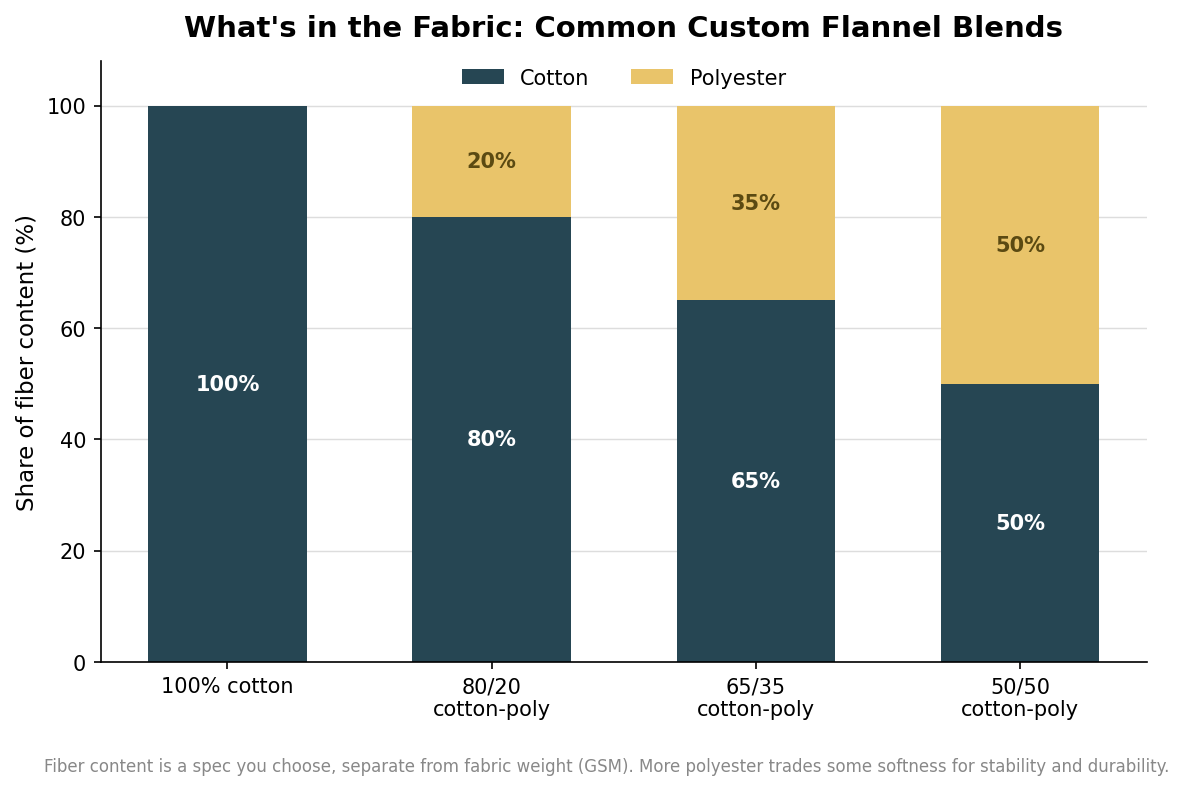
    Stacked bar chart showing cotton versus polyester percentage in 100% cotton, 80/20, 65/35, and 50/50 custom flannel blends
    More polyester in the blend trades softness for stability and durability.

    Blends are not a single thing. An 80/20 leans cotton and feels close to pure cotton while gaining some stability; a 65/35 sits in the practical middle; a 50/50 maximizes durability, shape retention, and shrink resistance at the largest cost to softness. The more polyester in the mix, the more the shirt behaves like a workwear or uniform piece and the less it behaves like a soft weekend flannel.

    Shrinkage is the spec that bites team orders

    Shrinkage matters most when you are ordering a run of sized garments for a group, because a shirt that fits in the box can fit differently after the first home wash. If everyone launders on hot and tumble dries, a 100 percent cotton order can drift a full size for some wearers, while a blend holds much closer to its labeled measurements. The two ways to protect a sized order are to specify pre-shrunk cotton, or to choose a blend, and then to give recipients simple care guidance.

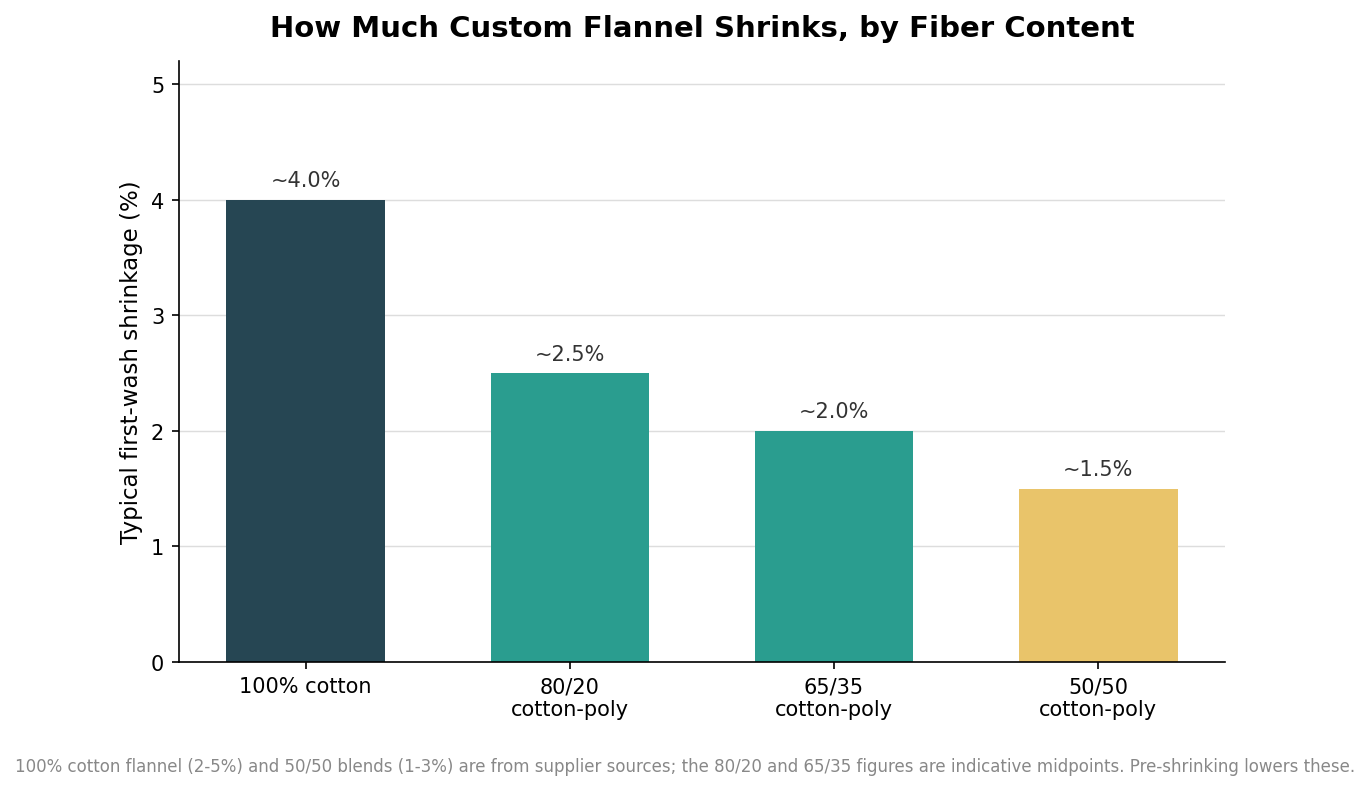
    Bar chart of typical first-wash shrinkage percentage for 100% cotton flannel versus cotton-poly blends
    Shrinkage falls as polyester content rises, which matters most for sized team orders.

    Care instructions do real work here. Washing in cold or lukewarm water on a gentle cycle, drying on low heat or air drying, and pulling shirts out while still slightly damp keeps both cotton and blends near their intended size. It is worth printing that guidance on a hang tag or an insert for a customer-facing order, since the fabric you chose only performs as intended if it is laundered the way it was designed for.

    Matching the fabric to the job

    The choice gets easier once you tie it to how the shirt will be used. For retail merch, premium gifts, and hospitality or lifestyle brands where the flannel is part of the appeal, lean toward 100 percent cotton, ideally pre-shrunk, and accept a little more care and wrinkling in exchange for the best hand. For uniforms, field crews, event staff, and any setting where shirts are washed hard and often and need to look consistent across a whole team, a 65/35 or 50/50 blend earns its keep through shape retention, shrink resistance, and longer-lasting decoration. An 80/20 is a sensible hedge when you want most of cotton’s feel with a measure of insurance against shrinkage.

    Decide fiber and weight together

    Fiber content and fabric weight are two separate dials, and the best orders set them deliberately as a pair. A heavier brushed cotton makes a plush, cool-weather shirt but leans into cotton’s shrink and wrinkle tendencies; a mid-weight blend makes a durable, low-maintenance shirt that holds up to constant laundering. Decide first what the shirt has to survive and how soft it has to feel, choose the fiber content to match, then pick a weight in that fabric, and confirm both on the spec sheet before the order runs. Getting fiber content right up front is what keeps a flannel order from feeling like the wrong shirt once it has been through a few washes.

    Create your custom flannel shirts now.

    Send your logo, quantity and date — you’ll get a free mockup and quote within one business day.

    Get a Quote
    GET A QUOTE
  • Custom Flannel Sizing and Fit: Five Mistakes That Sink Team Orders

    Custom Flannel Sizing and Fit: Five Mistakes That Sink Team Orders

    Call or Text us: (929) 605-4397

    Custom Flannel Sizing and Fit: Five Mistakes That Sink Team Orders

    A custom flannel program looks simple next to a full uniform rollout: pick a plaid, add a logo, choose a size run, done. Then the boxes arrive, half the crew says the shirts run big, the cotton ones tighten up after the first wash, and the embroidered logo disappears into the pattern from six feet away. None of those outcomes are bad luck. They are the predictable result of a handful of decisions made too fast at the order stage. Here are the ones that most often go wrong on a custom flannel order, and what to do instead.

    Ordering by label size instead of measured chest

    The single most expensive assumption is that a medium is a medium. Flannel is cut by brand and by fit block, and the same person can wear three different labeled sizes across three makers. A body chest of 40 inches lands in a medium on one chart and a large on another, and layering intentions push it further. The fix costs an afternoon: collect an actual chest measurement for each wearer, or at minimum pass a full physical size run around the team and let people self-select against real garments. Then order to the maker’s own chart, not to a generic assumption about what each letter means. It helps to remember that a printed chart usually lists body measurements, the person, while a tech pack lists garment measurements, the shirt laid flat, and the gap between them is the ease built into the fit. Confusing the two is how an order ends up uniformly a size too tight or too loose across the whole team.

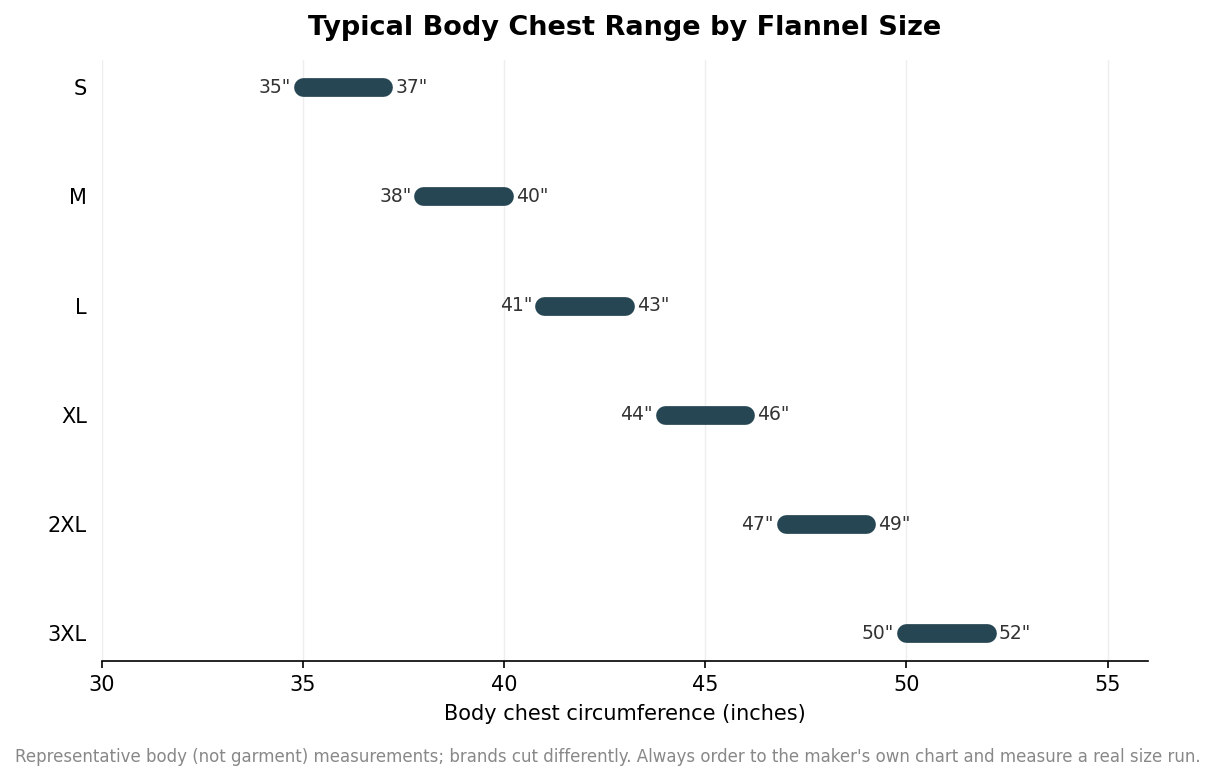
    Range chart of typical body chest measurements in inches for flannel sizes small through 3XL
    Representative body chest ranges by size; always confirm against the maker’s own chart.

    Ignoring how much cotton flannel shrinks

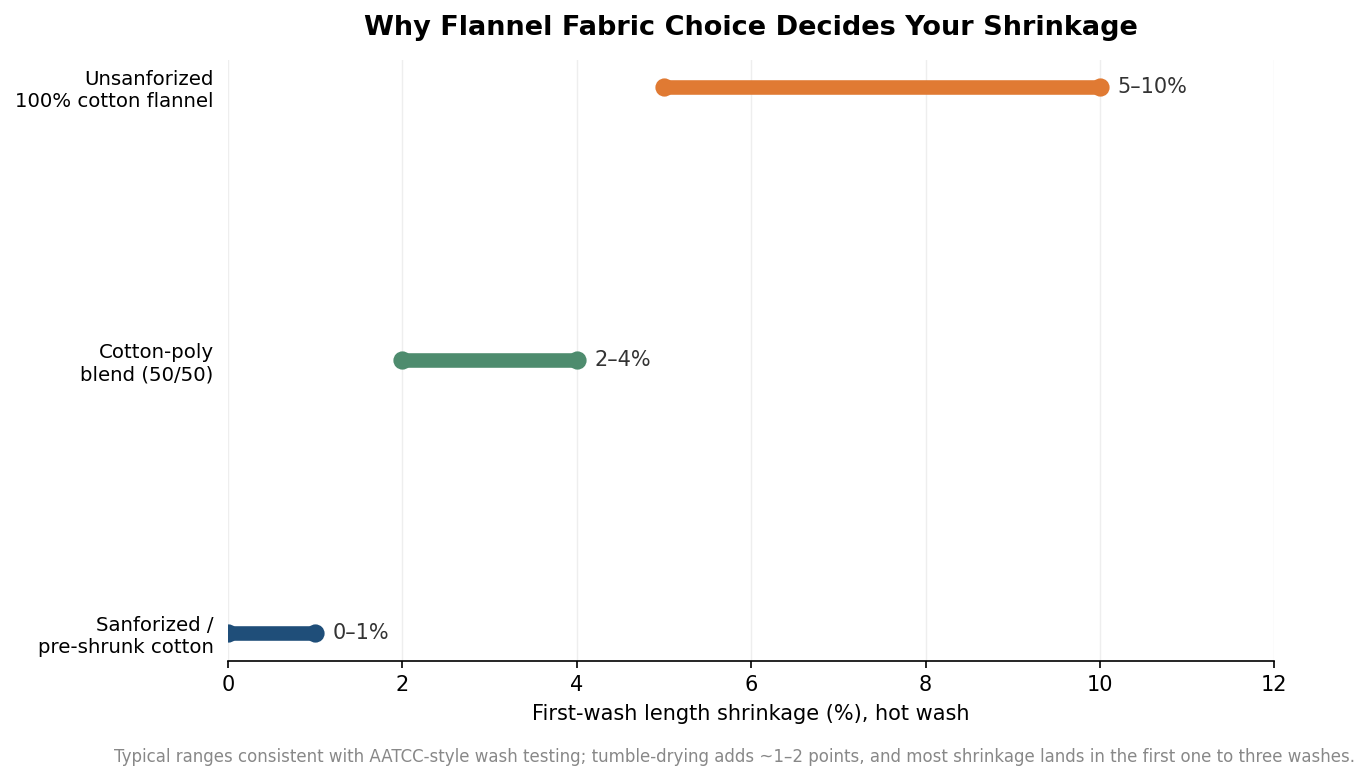
    Flannel’s warmth comes from a brushed cotton nap, and untreated cotton moves in the wash. In AATCC-style testing, an unsanforized 100 percent cotton woven can lose roughly 5 to 10 percent of its length on a first hot wash, with most of the total change happening in the first one to three launderings and tumble-drying adding another point or two. A shirt that fit at delivery can come back a size shorter in the body and sleeves. There are two clean ways around it. Specify a sanforized or pre-shrunk fabric, which holds residual shrinkage to about one percent on a woven, or choose a cotton-polyester blend, which typically settles in the 2 to 4 percent range because the polyester stabilizes the cloth. If you must run untreated cotton for the hand-feel, size up deliberately and tell wearers to wash cold and dry low.

    Range chart of first-wash shrinkage percentage for unsanforized cotton, cotton-poly blend, and sanforized cotton flannel
    Fabric choice, not luck, sets how much a flannel shrinks in the first few washes.

    Picking the wrong fit block for how it gets worn

    Fit is not just slim versus regular; it is a decision about what goes underneath. A slim or tailored block looks sharp on a host or a retail floor but fights a hoodie or a base layer. A classic cut suits most mixed teams. A relaxed or jacket block is the right call when outdoor staff will wear the flannel as an overshirt across a tee and a sweatshirt through a cold shift. Sleeve and body length matter as much as chest here, because a flannel worn open as a layer needs enough length to stay tucked or to sit right untucked. Decide the wear scenario first, then pick the block that serves it, rather than defaulting to whatever the blank supplier lists first. A useful test is to try the sample over the thickest layer your team will actually wear underneath; if the buttons strain or the shoulders bind with that layer on, the block is wrong regardless of what the chest number says.

    Decorating over the plaid without planning for it

    A plaid is a busy, multi-color background, and it does to a logo exactly what camouflage does to a shape. Fine embroidery detail and thin screen-printed lines get swallowed by the check, and thread colors that pop on a solid can vanish on a dark tartan. The practical moves are to keep the decoration bold and simple, to place it on the calmest available real estate such as a solid yoke, a pocket, or a sleeve panel, and to consider a woven or leather-style patch that gives the mark its own clean field instead of fighting the pattern. Whatever the method, approve a stitch-out or a printed proof on the actual plaid you ordered, not on a white mockup, because legibility is a property of the combination, not the logo alone.

    Skipping the pre-production sample and the buffer

    The last mistake is treating the first production run as the proof. On a custom apparel order, the sample stage is where you catch the shrinkage, the fit block, and the decoration legibility all at once, while changes are still cheap. Ask for a physical pre-production sample in your exact fabric and decoration, wash it, and only then release the bulk quantity. Build a modest buffer into the size run as well, because the tails of the curve, the extra 3XL and the occasional small, are the sizes you cannot easily add later without a second setup charge. Where a supplier quotes minimums, lead times, or price breaks, treat those as indicative until fabric, decoration, and the full size split are locked, since each of those still moves the number. Get the sample right and the rest of the order stops being a gamble, because every variable that could have surprised you has already been settled on a shirt you can hold. That is the difference between a program the team actually wears and a closet full of returns.

    Create your custom flannel shirts now.

    Send your logo, quantity and date — you’ll get a free mockup and quote within one business day.

    Get a Quote
    GET A QUOTE
  • Comparing the Most Popular Custom Flannel Blanks: Weight, Fit, and Decoration

    Comparing the Most Popular Custom Flannel Blanks: Weight, Fit, and Decoration

    Call or Text us: (929) 605-4397

    Comparing the Most Popular Custom Flannel Blanks: Weight, Fit, and Decoration

    When a business orders custom flannel, most of the decisions that determine whether people actually wear the shirt are made before a single stitch of embroidery goes down. The blank you choose sets the weight, the fit, the fiber blend, the size range, and how cleanly a logo will sit on the chest. The decorated-apparel industry keeps coming back to a short list of flannel blanks, and they are not interchangeable. This is a side-by-side look at three of the most commonly ordered models, what the spec sheets actually say, and how those differences play out once the shirt is on a body.

    The three that show up on almost every quote

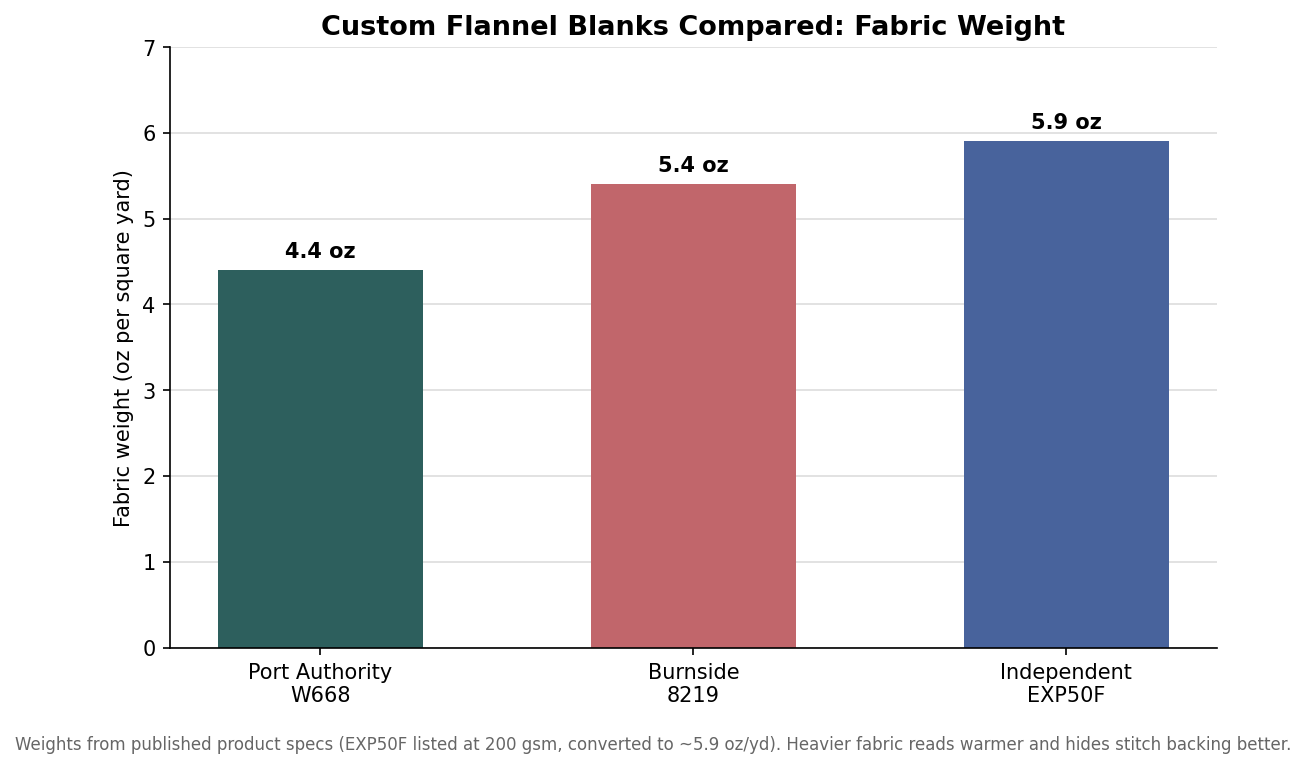
    If you gather quotes for branded flannel, you will keep seeing the same names. The Port Authority W668 is the lightweight, retail-styled option: a 60/40 cotton-poly plaid listed at roughly 4.4 ounces per square yard, lightly brushed, with a bias-cut back yoke, double chest pockets with flaps, and a size range that runs XS through 4XL. The Burnside 8219 is the heavier, more rugged snap-front shirt, an 80/20 cotton-poly build listed around 5.4 ounces with two chest pockets, roll-up sleeves, and adjustable cuffs. The Independent Trading EXP50F sits at the top of this group for substance, a 60/40 blend listed at 200 gsm, which works out to about 5.9 ounces per square yard, cut as a unisex shirt-jacket with double flap pockets, roll-up sleeve vents, and a tear-away neck label, in XS through 3XL.

    Bar chart comparing fabric weight of three custom flannel blanks: Port Authority W668 at 4.4 oz, Burnside 8219 at 5.4 oz, Independent EXP50F at about 5.9 oz
    Published fabric weights for three common custom flannel blanks, from lightweight to jacket-like.

    That weight spread from about 4.4 to 5.9 ounces looks small on paper but is very noticeable in hand. The W668 wears like a shirt you would layer under a jacket; the EXP50F wears like the jacket. If your team will live in these shirts through a cold season, or if you want the garment to read as a premium giveaway, the heavier fabric justifies its higher blank cost. If the flannel is a warm-weather brand piece or a uniform layer worn indoors, the lighter W668 is more comfortable and usually less expensive per unit.

    Fiber blend changes care as much as feel

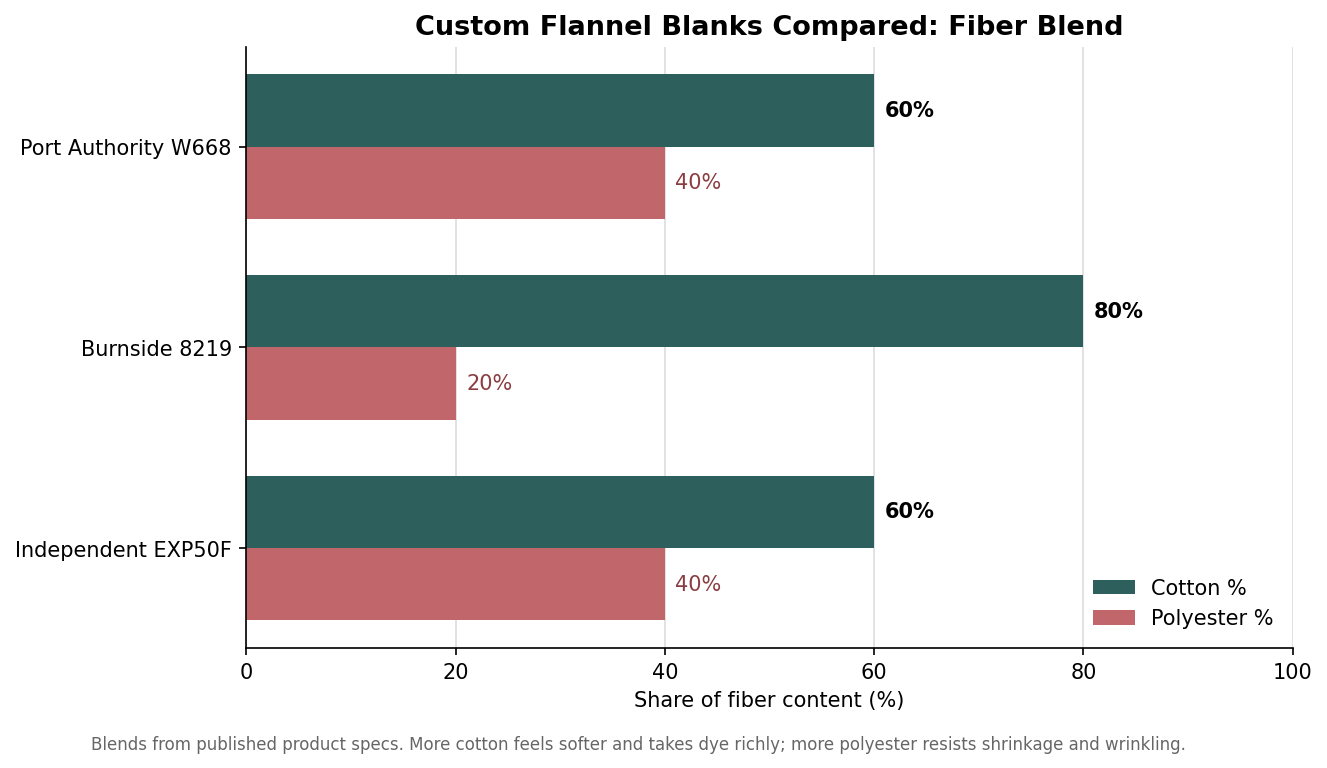
    The cotton-to-polyester ratio is the spec buyers overlook most, and it drives two things that matter after the sale: how the shirt feels and how it survives laundering. The Burnside 8219 leans hardest into cotton at 80/20, which gives it the softest, most natural hand and the richest color in a yarn-dyed plaid, at the cost of more shrinkage and wrinkling over time. The W668 and EXP50F both sit at 60/40, trading a little softness for meaningfully better shrink resistance and easier care, which is exactly what you want when a shirt is worn hard and washed often by staff who will not baby it.

    Grouped bar chart of cotton versus polyester content: W668 and EXP50F at 60/40, Burnside 8219 at 80/20
    Fiber blends compared; more cotton feels softer, more polyester resists shrinkage and holds shape under embroidery.

    There is a decoration angle here too. Higher cotton content takes dye deeply and gives embroidery a plush, slightly recessed look as the stitches settle into a brushed surface. A higher-polyester blend holds its shape better under a hoop and is less prone to the puckering that can show up when dense stitching pulls on an all-cotton weave. Neither is wrong; it is a question of whether you are optimizing for the softest hand or the crispest, most stable logo.

    Fit, size range, and who actually gets a shirt that fits

    Size range is a practical constraint that quietly decides how inclusive your order can be. The W668’s XS-through-4XL run is the broadest of the three and the safest choice for a mixed team where you cannot predict who needs what. The EXP50F tops out at 3XL and is cut unisex, which simplifies ordering but fits differently on different body types, so it is worth ordering a couple of sizes as samples before committing a whole staff. Burnside publishes its 8219 in a modern fit that runs closer to the body than a traditional boxy flannel, which flatters some wearers and frustrates others; if in doubt, size up.

    Where a garment offers a distinct women’s or ladies’ counterpart, ordering it rather than handing everyone the same unisex cut is usually the difference between a shirt that gets worn and one that lives in a drawer. The point of branded flannel is that people choose to put it on, and fit is the biggest lever on that.

    Matching the blank to the job

    Reduced to a decision, the pattern is straightforward. Choose the lighter W668 when you want a broad size range, a lower per-unit cost, and a retail look for a warm climate or an indoor uniform. Choose the Burnside 8219 when you want the softest, most authentic cotton hand and the character of a snap-front work shirt, and you can accept a little more shrinkage in exchange. Choose the Independent EXP50F when you want the most substantial, jacket-like piece that will read as a premium item and hold up as outerwear.

    Two things to confirm before you sign off, regardless of model. First, order blank samples in the exact colors and a couple of sizes so you can feel the weight and check the fit rather than trusting a spec sheet alone; the numbers here are drawn from published product specifications and are a starting point, not a substitute for handling the garment. Second, pin down the decoration method and placement early, because an 80/20 brushed cotton and a 60/40 blend do not behave identically under a needle, and a quick stitch-out on the actual fabric will tell you more than any comparison chart. Get the blank right and the branding is the easy part.

    Create your custom flannel shirts now.

    Send your logo, quantity and date — you’ll get a free mockup and quote within one business day.

    Get a Quote
    GET A QUOTE
  • Flannel Weight, Explained: Choosing the Right GSM for Custom Flannel

    Flannel Weight, Explained: Choosing the Right GSM for Custom Flannel

    Call or Text us: (929) 605-4397

    Flannel Weight, Explained: Choosing the Right GSM for Custom Flannel

    Fabric weight is the specification most buyers skip when ordering custom flannel, and it is the one they notice every time the shirt goes on. Weight decides whether a flannel reads as a breathable overshirt or a structured shacket, how a print or stitch sits on the brushed surface, and how much the garment shrinks after its first wash. Nailing it down at the order stage costs nothing. Getting it wrong means a run of shirts that feel thin, pill within a season, or no longer match the size chart you approved.

    Choosing between two ways to add warmth? See our heavyweight vs. sherpa-lined flannel shirts comparison.

    How flannel weight is actually measured

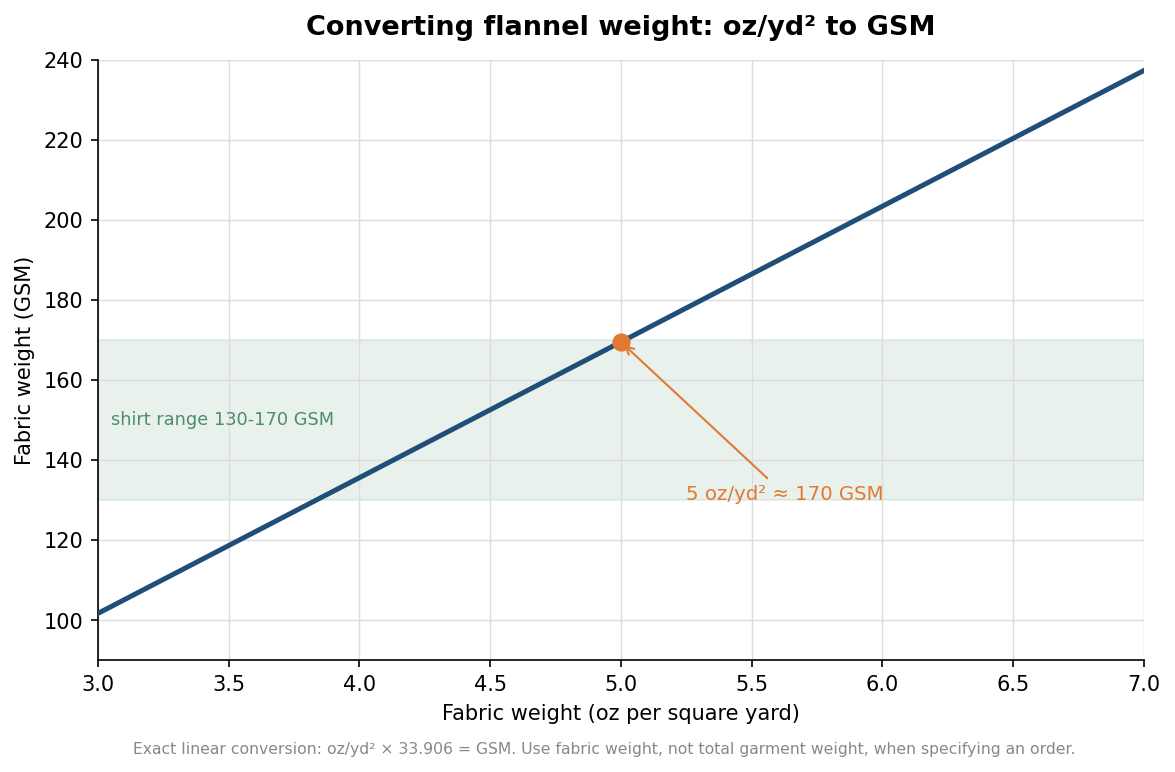
    Flannel weight is quoted two different ways, and confusing them is where orders go sideways. The number that matters for fabric is weight per unit area, given either in grams per square meter (GSM) or ounces per square yard (oz/yd²). The two convert directly: multiply oz/yd² by 33.906 to get GSM, so a common 5 oz/yd² flannel works out to roughly 170 GSM. Shirt-weight flannel generally sits between about 130 and 170 GSM, or 3.8 to 5.0 oz/yd².

    The second figure you will see, usually in retail marketing, is total garment weight — a brand calling a shirt “over 15 ounces,” for instance. That number describes the finished garment, buttons and all, and it is not comparable to fabric GSM. It is useful shorthand for “this feels substantial,” but it is the wrong figure to spec an order against. When you brief a decorator or manufacturer, always give GSM or oz/yd².

    The three weight classes and what each is for

    Lightweight flannel runs about 102 to 140 GSM (3.0 to 4.1 oz/yd²). It drapes softly and breathes, which suits warm-weather shirting, women’s blouses, and promotional shirts meant to be worn indoors or layered lightly. Midweight, roughly 150 to 170 GSM (4.4 to 5.0 oz/yd²), is the classic plaid shirt most people picture: warm enough for fall, structured enough to hold a logo cleanly, light enough to wear all day. Heavyweight starts around 200 GSM (5.9 oz/yd² and up) and crosses into shacket and light-outerwear territory. For most custom flannel programs, the 130 to 170 GSM band is the safe target; go lighter for events and giveaways, heavier only when the shirt is meant to function as a jacket. Keep in mind that mills quote a nominal weight with a tolerance of a few percent, so a fabric sold as 160 GSM may test slightly above or below that figure; if the spec is tight, ask what tolerance the mill works to.

    Horizontal bar chart of flannel fabric weight ranges in GSM by use, from lightweight shirting to heavyweight shackets
    Shirt-weight flannel clusters in the 130-170 GSM band; heavier weights cross into shacket territory.

    Heavier is not automatically warmer

    It is tempting to read GSM as a warmth score, but that is not how flannel works. Warmth comes largely from the brushed nap that traps air against the body, and brushing quality varies independently of weight. A well-executed double-brushed 160 GSM flannel can feel warmer than a flat, single-brushed 180 GSM one, because the raised fibers do more of the insulating work. This is why premium makers emphasize double brushing, which raises surface fibers on both faces of the cloth. The tradeoff to watch is pilling: heavier flannels often rely on softer, lower-twist yarns, and those tend to pill more readily than a tightly spun midweight. If longevity across many washes matters more than maximum plushness, a well-made midweight is frequently the smarter buy.

    Line chart converting flannel weight from ounces per square yard to GSM, marking the 5 oz equals 170 GSM anchor
    Fabric weight converts linearly: ounces per square yard times 33.906 equals GSM.

    How weight changes the rest of your order

    Decoration behaves differently on different weights. Embroidery sits well on midweight and heavier napped fabric, where the base cloth supports a dense stitch — a reason it is the go-to for left-chest logos and names. Screen printing is strongest for bold, solid areas of color, but fine detail can sink into a raised nap, so on heavily brushed fabric many shops steer detailed or photographic art toward direct-to-film (DTF) instead. Minimums and add-on costs track the method, so confirm them with your supplier; here, the minimum order is 12 shirts, and add-ons such as individual names are priced on your quote.

    Shrinkage quietly moves your size chart. Brushed cotton flannel typically carries a 5 to 6 percent shrinkage allowance, while Sanforized fabric can hold under 3 percent. On a shirt sized for a 42 to 45 inch chest at Large, an unmanaged 5 to 6 percent can pull the garment down close to the next size after washing. Before you approve a size chart, ask two questions: is the fabric Sanforized, and are the measurements pre-wash or post-wash. Getting those answers in writing prevents the most common post-delivery complaint, which is that the shirts “came up small.”

    Weight also nudges lead time. Decorating stock flannel blanks is fast — standard turnaround is about 2 weeks for straightforward jobs — while cut-and-sew from a chosen fabric weight takes considerably longer and should be planned weeks out. If you have a hard in-hand date, lock the weight and blank early rather than late.

    How to specify it cleanly

    When you place the order, hand your supplier five things: the fabric weight in GSM or oz/yd², the composition (100 percent cotton versus a cotton-poly blend), the brushing (single or double), whether the fabric is Sanforized, and the decoration method matched to that weight. Those five lines turn “a nice flannel” into a spec a factory can actually hit, and they are the difference between a sample you love and a bulk run that matches it. It also helps to order and keep a sealed reference sample of the approved fabric, so any disagreement over a production run can be settled against a physical standard rather than someone’s memory of how the sample felt.

    Create your custom flannel shirts now.

    Send your logo, quantity and date — you’ll get a free mockup and quote within one business day.

    Get a Quote
    GET A QUOTE
  • Embroidery vs Screen Printing on Flannel

    Call or Text us: (929) 605-4397
    Specs

    Embroidery vs Screen Printing on Flannel

    On flannel, this is a durability question

    On a tee this is mostly a style question. On brushed cotton flannel it is a durability question, and the wrong answer shows up after about six washes.

    What the nap does to your artwork

    Flannel is brushed, so the surface has a raised nap. Fine printed detail sinks into it and fine embroidery detail can disappear if the logo has not been digitized for the coarser weave. This is why artwork that looked crisp on a sample tee can land soft on flannel.

    Where embroidery wins

    Chest logos, sleeve marks and anything on a shirt that will be washed weekly for years. Thread is worked into the fabric rather than sitting on it, so there is nothing to crack or peel.

    Where screen printing wins

    Anything large. A full back panel in embroidery is slow and costly, and stiffens the garment. Print handles big illustrated artwork at a fraction of the price, and with the right inks it stays flexible on brushed cotton.

    The practical answer is usually both

    Stitch the chest, print the back, on the same shirt, in the same order. Minimum order is 12 shirts, production runs 2 weeks, and your free mockup arrives within 24 hours.

    Create your custom flannel shirts now.

    Send your logo, quantity and date — you’ll get a free mockup and quote within one business day.

    Get a Quote
    GET A QUOTE
  • Why Staff Wear Branded Flannel and Not Branded Polos

    Call or Text us: (929) 605-4397
    Uniforms

    Why Staff Wear Branded Flannel and Not Branded Polos

    The item they wear on their day off

    Ask any brewery or coffee roaster which uniform item goes home with staff and comes back next winter. It is never the polo. Understanding why is worth more than the design brief.

    It works as normal clothing

    A flannel reads as a garment someone might have bought themselves. A logo polo reads as a uniform in every context outside work. When the shirt passes as ordinary clothing, your branding travels far beyond the premises at no extra cost.

    Keep the branding restrained

    This is the part most programs get wrong. A discreet stitched chest logo keeps the shirt wearable everywhere. A huge chest print turns it back into a uniform and it stops leaving the building.

    Fit decides whether it gets worn at all

    No amount of design saves a shirt that does not fit. Offer a real women’s block alongside the standard one, and order the size run properly rather than guessing.

    Budget for the shirt they keep

    A flannel costs more than a tee and lasts several times longer, and it is worn voluntarily. Minimum order is 12 shirts, production runs 2 weeks, and the mockup is free within 24 hours.

    Create your custom flannel shirts now.

    Send your logo, quantity and date — you’ll get a free mockup and quote within one business day.

    Get a Quote
    GET A QUOTE
  • Custom Flannel Shirts: A Buyer’s Guide

    Call or Text us: (929) 605-4397
    Buyer’s guide

    Custom Flannel Shirts: A Buyer’s Guide

    Why flannel outperforms the branded tee

    Flannel is the rare branded garment people wear when nobody is making them. That only holds if you get three things right: the decoration method, the weight, and whether you offer more than one fit.

    Embroider the chest, print the back

    Thread worked into the fabric cannot crack or peel, which is why a stitched chest logo still looks deliberate after two winters. But embroidering a full back panel is slow and expensive, so large artwork belongs in screen print. Most good flannel programs use both on the same shirt.

    Match the weight to the wearer

    A fashion-weight flannel on an outdoor crew blows out at the seams within a season. A heavyweight shirt on indoor counter staff is simply too warm. Decide where the shirt will actually be worn before you pick the fabric, not after.

    One fit is not enough

    The most common reason uniform shirts sit unworn is that half the team was issued a small men’s shirt. A real women’s block changes the shoulder, bust and waist. If you want the shirts actually worn, order both.

    Consider the lined version for gifts

    A sherpa lining turns the shirt into a light jacket, which is the difference between an item that is kept and one that is donated. It costs more per unit and it is almost always the right call for client gifts.

    What to expect when you order

    Send whatever artwork you have. You will get a free mockup within 24 hours, unlimited free revisions, and you pay nothing until you approve it. Minimum order is 12 shirts and production runs 2 weeks, with faster turnaround available on express shipping.

    Create your custom flannel shirts now.

    Send your logo, quantity and date — you’ll get a free mockup and quote within one business day.

    Get a Quote
    GET A QUOTE